Banco Santander (SAN)·Q4 2025 Earnings Summary
Santander Posts Record €14.1B Profit, Stock Drops 7% on $12.2B Webster Acquisition
February 03, 2026 · by Fintool AI Agent
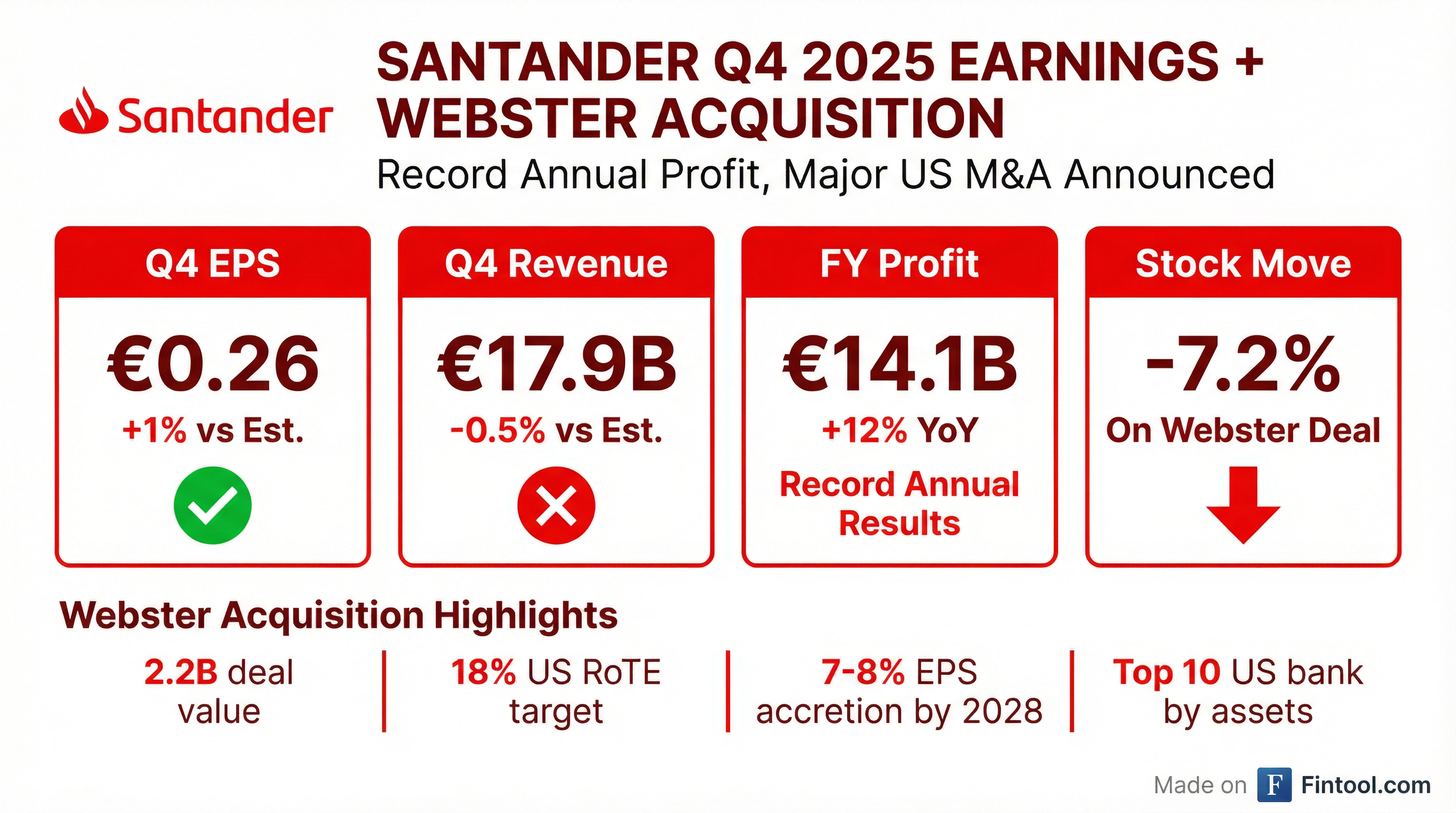
Banco Santander delivered record annual results with €14.1 billion in attributable profit for FY2025, up 12% year-over-year, while announcing a transformative $12.2 billion acquisition of Webster Bank that sent shares tumbling 7.2%.
The Q4 quarter itself saw a narrow EPS beat (+1.0%) against a slight revenue miss (-0.5%), but the market's focus was squarely on the Webster deal—a bold move that transforms Santander's US franchise into a top-10 retail and commercial bank by assets.
Did Santander Beat Earnings?
*Values retrieved from S&P Global
The full-year results showed broad-based strength:
- Customer growth: +8 million new customers, reaching 180 million globally
- Revenue: Up 4% in constant euros, with fee income +9% on global business network effects
- Efficiency ratio: Improved to ~41%, showcasing One Transformation benefits
- Net operating income: Record €37 billion
- Cost of risk: 1.15%, in line with guidance
- Dividend per share: +14% growth, with €10B+ committed to buybacks for 2025-2026
 Ask Fintool AI Agent
What's the Webster Bank Acquisition?
The headline grabber was Santander's announcement of its intent to acquire Webster Financial Corporation for $12.2 billion, creating a combined US entity that will be the 10th largest retail and commercial bank in the country.
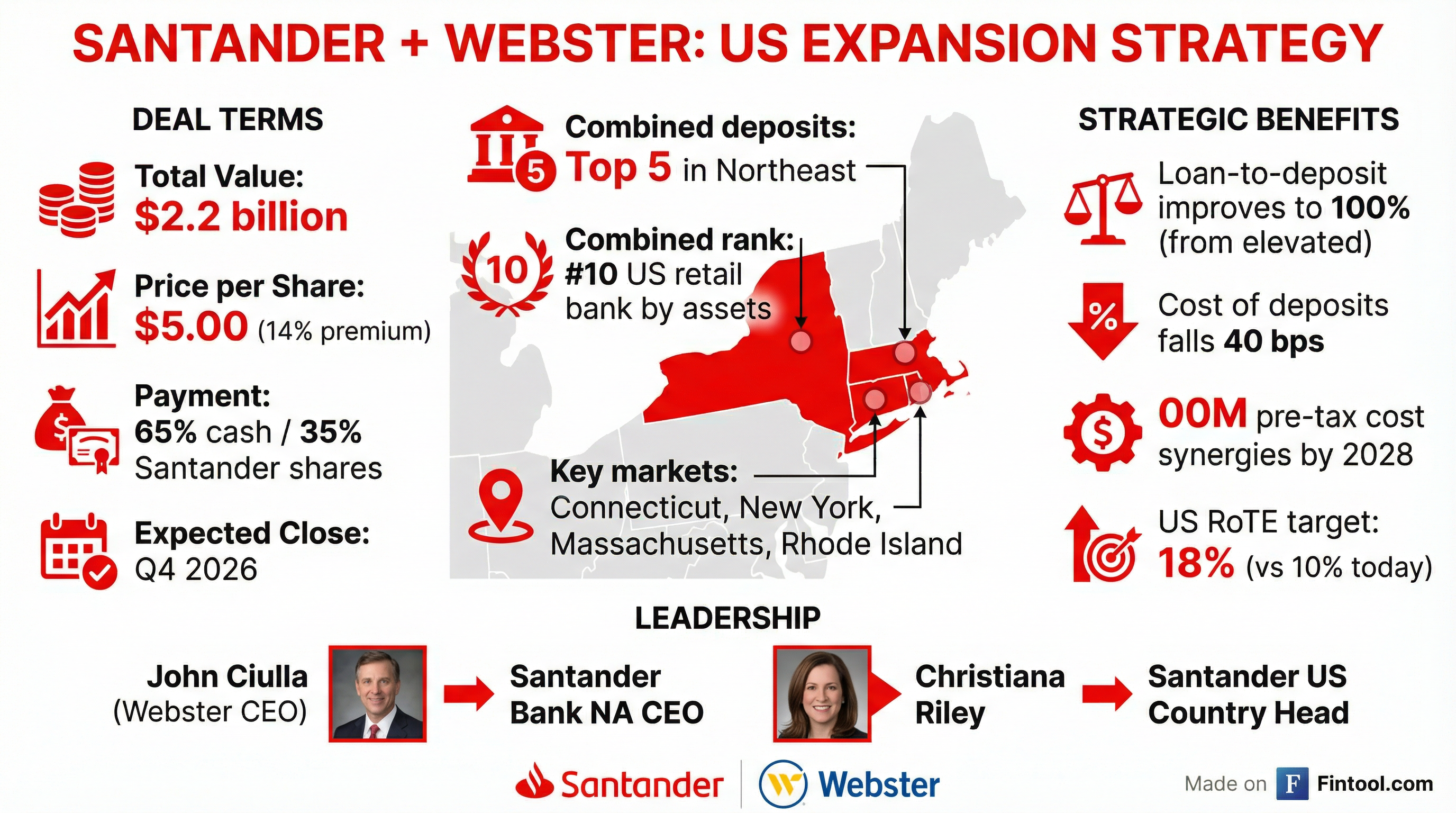
Deal Terms
Strategic Rationale
CEO Ana Botín framed Webster as the final piece needed to make Santander US "best-in-class":
"Santander US has made huge progress... into building a sustainable and more profitable model every year. Over the last 3 years, profits have grown by over 30%... Webster brings a very strong commercial bank, which complements our consumer bank."
The combination addresses Santander's key US weaknesses:
- Funding gap: Loan-to-deposit ratio improves to ~100% (from elevated levels)
- Deposit costs: Average cost of deposits falls 40 bps on Webster's HSA business
- Commercial banking: Webster's 80% commercial / 20% retail mix fills Santander's retail-heavy gap
- Cost of risk: Falls to 1.3% from 1.6% standalone
Synergy Targets
Revenue and funding synergies were explicitly excluded from guidance—management sees these as "upside."
How Did the Stock React?
Santander shares dropped 7.2% on the earnings + acquisition announcement, falling from $13.06 to a low of $11.82 intraday before recovering slightly to $12.08 at close.
The selloff reflects investor concerns about:
- Dilution: 35% of the deal paid in new Santander shares (~2.05 shares per Webster share)
- Capital consumption: 140 bps hit to CET1, bringing it to ~12.8% at close
- Execution risk: Despite management's 15% ROIC guidance, some questioned whether 20% hurdle rates should apply to US deals
Management defended the math aggressively:
"At €11, share buybacks return 9% to shareholders. This will return 15%... Over the last 5 years, the US has been top three in terms of geographies for Santander and value creation."
Ask Fintool AI AgentWhat Did Management Guide?
2026 Outlook (Ex-M&A)
2027-2028 Targets
The jump from 16.3% ROTE today to >20% by 2028 is driven by:
- UK improvement (TSB integration) contributing >1 pp
- US improvement (Webster + organic) contributing ~1 pp
- Brazil, Spain, and Consumer Bank continuing to improve
- Insurance business scaling as a "biggest upside for fees"
What Changed From Last Quarter?
Management was emphatic this is the last major acquisition:
"No more bolt-on acquisitions. The next three years, clearly not... We are at scale in all our core markets."
Key Q&A Highlights
On synergy confidence:
"We have done extensive due diligence... On the commercial side, we're gonna shut down our systems and go onto theirs. Simple. On the front end for consumers, we're gonna use Open Bank. APIs are easy. We know how they work."
On commercial real estate concerns (Webster's CRE book):
"We have people in the U.S. that understand this business. They've looked at the books. We think they're absolutely clean. They have a strong portfolio."
On the 15% ROIC vs 20% hurdle:
"We're being very consistent with our capital hierarchy... the spread between share buybacks when we did TSB and today, it's exactly the same. At €11, the share buybacks is 9%, ROIC is 15. That's six points."
On integration timeline:
"We're gonna slow down One Transformation [in UK/US]... We'll focus One Transformation more on countries like Brazil, Mexico, Spain, Chile."
Segment Performance
The earnings transcript highlighted strong performance across global businesses:
Capital Allocation & Shareholder Returns
The €5B buyback program begins February 4, 2026, including €3.2B from Poland sale proceeds.
Ask Fintool AI AgentLooking Ahead: Investor Day February 25
Management promised more detailed targets at the upcoming Investor Day on February 25, 2026. Key items to watch:
- Detailed ROTE bridge from 16.3% to >20%
- Integration milestones for TSB (expected close Q2 2026) and Webster (Q4 2026)
- Updated One Transformation rollout timeline
- Brazil and Mexico organic growth initiatives
- Insurance business scaling strategy
The Bottom Line
Santander delivered exactly what it promised on the organic business—record profits, improved efficiency, strong capital generation. But the Webster acquisition stole the show, and the market voted with its feet (-7.2%).
The bull case: Webster transforms Santander into a best-in-class US bank at a reasonable 6.8x post-synergy P/E, with 15% ROIC beating the 9% buyback alternative. The bear case: execution risk on a $12.2B US bank deal, 140 bps capital hit, and share dilution in an already complex global structure.
Management's "no more bolt-ons" promise and >20% ROTE target for 2028 will now be the measuring stick. Investor Day on February 25 should provide more clarity on whether this ambitious vision is achievable.
Analysis based on Santander Q4 2025 earnings call transcript and public filings. Stock price data as of market close February 3, 2026.